
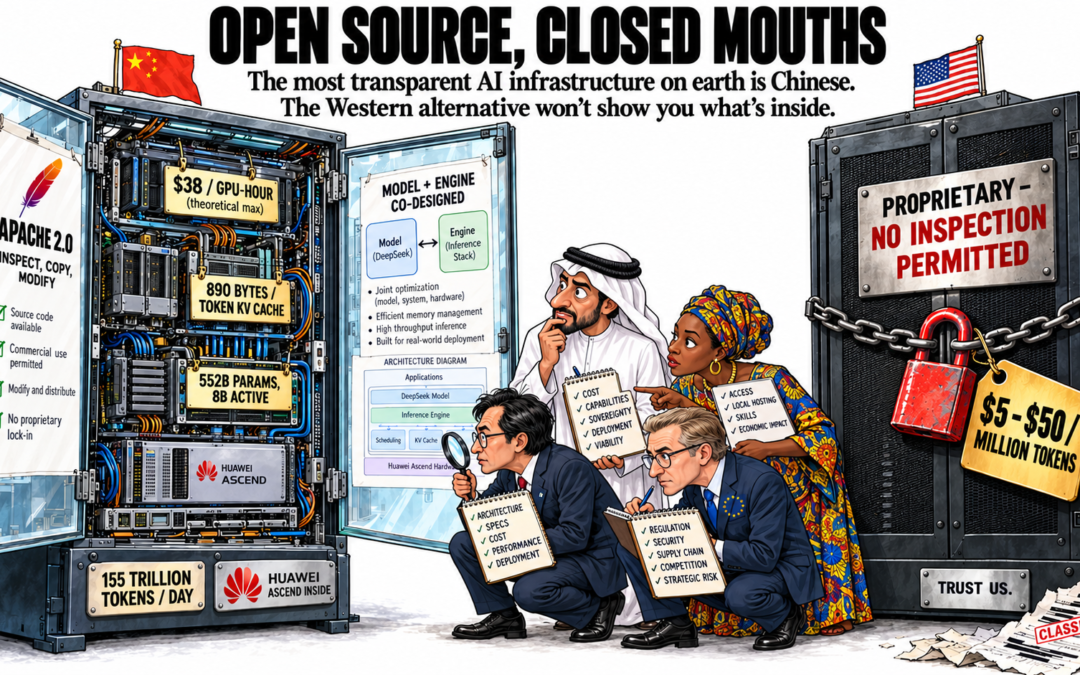
DeepSeek just disclosed that its production inference cluster can generate up to $38 per GPU per hour under theoretical maximum conditions, processing 155 trillion tokens daily across what it calls a "full-link" optimised stack. These are the first numbers of this kind any frontier AI lab has published.
No Western lab offers anything comparable in transparency. OpenAI and Anthropic do not open-source their inference engines, do not disclose per-GPU revenue, and charge $5 to $50 per million tokens while external analysts estimate their gross margins at roughly 55% and 60% respectively. Nobody outside those organisations can independently verify what the hardware-layer economics actually look like, because the serving infrastructure is entirely proprietary.
DeepInfer is not simply an open-source inference engine released under Apache 2.0. It is the first public proof that model architecture and inference infrastructure can be co-designed as a single system, with cost efficiency engineered into the model during pre-training rather than bolted on afterward. V4.1-Flash uses a 552-billion-parameter mixture-of-experts design that activates only 8 billion parameters per input token and 16 billion per output token. Its Compressed Sparse Attention reduces the KV cache to roughly 890 bytes per token, about a quarter of the prior generation. Cross-layer KV sharing halves prefill compute. A confidence-scheduled speculative decoding system, trained alongside the model, dynamically adjusts verification length per request based on cluster load. None of this is replicable through post-deployment optimisation, because the engine and the model were built as one thing from the start.
The sovereignty dimension is the part nobody in Washington or Brussels wants to say out loud. The most transparent, most self-hostable frontier AI stack on the planet is Chinese, runs natively on Huawei Ascend hardware outside US export control jurisdiction, and was released the same week Washington ordered federal agencies to purge DeepSeek from government systems. Reuters has reported that DeepSeek is designing its own inference chip targeting SMIC fabrication, which would close the last dependency on Western-controlled silicon.
For every government and enterprise building a sovereign AI capability, the question is now structural: when the most open, most auditable option comes from Beijing, and the Western alternative remains a closed API priced at whatever the provider decides, what exactly is the sovereignty proposition you are buying?
#DigitalSovereignty #DeepSeek #AIInference #SovereignAI #OpenSource