
Defining Digital Sovereignty: Scope, Meaning, and Limits
The term has been captured. This definition takes it back.
Digital sovereignty is the most consequential term in technology policy, and it has no working definition. What circulates instead are approximations calibrated to the interests of the actors who wrote them: vendor-aligned framings that stop short of testing authority, advisory models that substitute scoring for control, and policy declarations that assert autonomy while the infrastructure beneath them remains externally governed.
The structural flaw shared by every major treatment of digital sovereignty, from Floridi's informational self-determination to Zuboff's surveillance capitalism framework, from the European Union's strategic autonomy framing to the "sovereign cloud" product tiers sold by the same hyperscalers whose executives have confirmed under oath that they cannot guarantee sovereignty, is a single classification error. They evaluate control under stable conditions. They measure sovereignty while systems are running, contracts are honoured, and access is uninterrupted. This is the one circumstance under which sovereignty is never decided.
Sovereignty is decided at the point of withdrawal: the moment access is suspended, licences revoked, services terminated, infrastructure removed, or dependence imposed through contractual terms or infrastructure design. Leverage replaces consent and exit ceases to be theoretical. Every existing framework is silent on this moment, because the moment it is tested is the moment most sovereignty claims collapse.
This silence is not an oversight. It is a business model. An intermediary class of consultancies, advisory firms, standards bodies, and systems integrators has built a permanent economy on the absence of sovereignty, not its achievement. Maturity models replace power. Certification replaces control. "Sovereign" becomes a product label attached to systems that remain externally governed at the only point that matters: the ability to intervene, restrict, or withdraw.
What follows is the definition that closes that space.
Definition: Digital Sovereignty
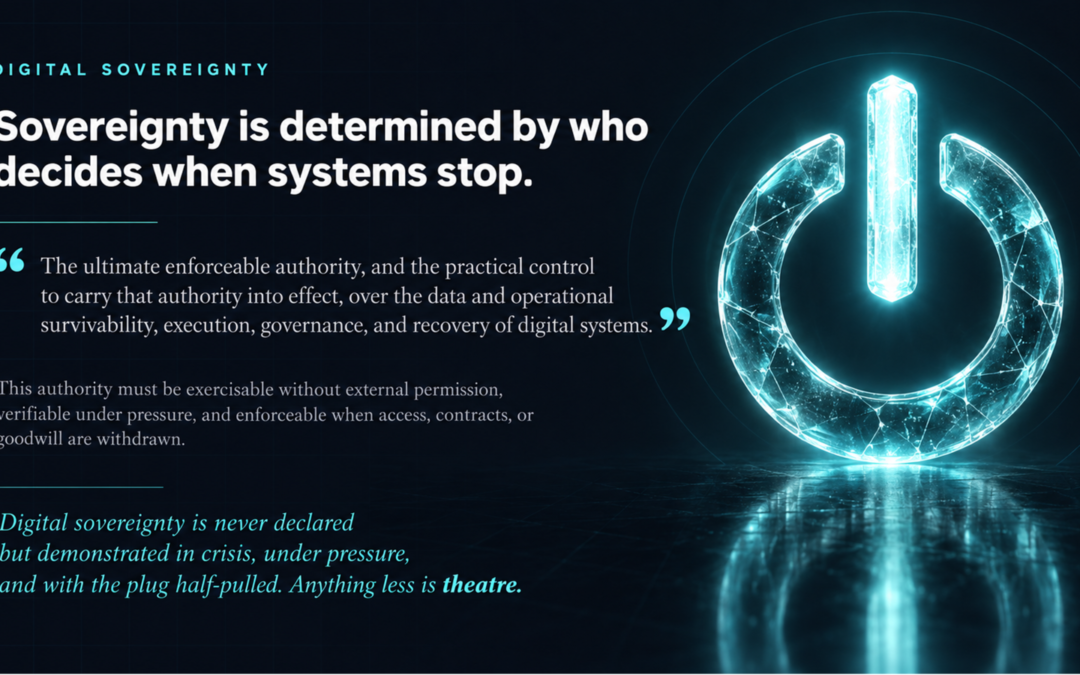
The ultimate enforceable authority, and the practical control to carry that authority into effect, of nations, organisations, communities, and individuals (collectively, the sovereign) over the data and operational survivability, execution, governance, and recovery of digital systems.
This authority and control must be visible, auditable, independently verifiable, structurally secured, operationally demonstrable, and enforceable by the sovereign, with capacity proportionate to the sovereign's scale and the criticality of the system. This capacity includes the skills, expertise, and operational knowledge required to exercise sovereign authority, which must be retained, directed, and substitutable under the sovereign's own control. It is a strategic capacity that must be exercised without external permission, not contingent on external authority, and carried into effect through the ability to build, operate, permit, constrain, deny, restore, migrate, substitute, or exit execution.
This capacity is compatible with voluntary participation in shared systems, markets, treaties, or standards only where entry, exit, enforcement, and remedy remain under the sovereign's own control within a defined operational boundary and where such participation does not degrade or subordinate sovereign authority during operation. Such participation cannot be unilaterally altered, revoked, or weaponised by an external actor.
It must be enforceable under the sovereign's own legal jurisdiction, such that disputes, interventions, audit rights, and remedies can be compelled in the sovereign's own courts and enforcement systems, within the sovereign's own time tolerance, and without reliance on foreign arbitration, extraterritorial law, or external discretionary authority that can prevent or indefinitely delay enforcement. Self-determination must be preserved without any form of externally imposed observation, whether overt or covert, embedded as a condition of access, operation, compliance, recovery, or continued use.
Digital sovereignty exists only where that authority and control remain effective without critical reliance on, or exposure to, any external actor, platform, vendor, jurisdiction, infrastructure, contractual condition, economic mechanism, or control path through which execution, continuity, recovery, substitution, migration, or exit can be constrained, degraded, or denied.
It fails wherever any external actor retains the capacity to withdraw, override, delay, compel, surveil, or block sovereign operation, or to impose economic, contractual, or licensing conditions that render execution, continuity, recovery, substitution, migration, or exit non-viable, by any means and through any mechanism, whether technical, legal, commercial, or operational.
Control Planes of Authority
Digital sovereignty is exercised across five control planes, each governing a distinct mechanism of authority. These planes are co-equal and non-substitutable. Authority must remain enforceable across all five simultaneously under conditions of refusal, withdrawal, or compulsion.
Technical control plane: the systems that permit, constrain, or deny execution, including compute, infrastructure, identity, key control, orchestration, update and signing control, and the technical standards and protocols that govern interoperability and access. It determines whether execution can occur by controlling authentication, authorisation, resource availability, scheduling, and the ability to start, restart, or withhold operation.
Legal control plane: the jurisdictional and enforcement mechanisms that permit, compel, restrict, delay, or deny operation through law, regulation, and extraterritorial reach, including injunction, sanction, seizure, and compliance orders applied to systems, data, and actors. It determines whether execution can proceed, be halted, be forced, or be rendered unlawful, irrespective of technical capability or declared authority.
Commercial control plane: the contractual, economic, and dependency mechanisms through which access, pricing, licensing, service continuity, and supply can be permitted, compelled, constrained, delayed, degraded, or denied, including terms of service, pricing models, billing control, credit enforcement, allocation, and lock-in structures applied to systems, data, and actors. It determines whether execution can proceed, be restricted, be forced under imposed terms, be made economically unviable, or be withdrawn through commercial pressure, irrespective of technical capability or legal authority.
Execution control plane: the mechanisms through which system functions are executed and operations are performed, including processing, transcription, inference, administration, configuration, access control, and incident response. These mechanisms determine where execution occurs, by whom it is performed, and where data is accessed, copied, or exfiltrated, and whether execution can be permitted or denied, irrespective of formal authority.
Narrative control plane: the information architectures through which sovereignty is defined, legitimacy is manufactured, power is recognised or rendered invisible, and discourse is bounded, including algorithmic curation, censorship, embedded bias, deliberate misinformation, sovereignty washing, and the asymmetric classification of equivalent conduct depending on the actor. It determines whether the interpretive environment within which the other four planes are evaluated and contested is authored and controlled by the sovereign or by an external actor, irrespective of technical capability, legal authority, or commercial arrangement.
If any condition fails in any control plane, the system is non-sovereign. No governance structure, contractual protection, or legal remedy overrides this classification.
The Survivability Condition
Authority survivability requires that sovereign control remain enforceable and not externally revocable under refusal, withdrawal, or compulsion across technical, legal, commercial, execution and narrative control planes. This condition applies identically to every domain tested. Variation arises from the structure of an actor's sovereign envelope across domains. It does not arise from the condition itself. Sovereignty must be assessed domain-by-domain, not by aggregate continuity.
Authority is not a formal designation but a condition that must hold under stress. Sovereignty must therefore be assessed not by continuity, compliance, or declared control, but by what endures when access is withdrawn. Operational continuity typically reflects tolerated access rather than retained authority, even if systems continue to operate normally. Systems that operate normally under stable conditions provide no evidence of sovereignty.
Sovereignty is not a static condition. It is maintained or lost over time as dependencies evolve, supply chains shift, legal conditions change, and operational knowledge decays. A system that satisfies the survivability condition at one moment may fail later if external dependency re-enters at a decisive point. Sovereignty must therefore be sustained, not merely achieved. Control that cannot be maintained over time has already begun to fail.
Absolute Digital Sovereignty Does Not Exist
No nation, organisation, or bloc operates in a state of complete independence. All actors inherit dependency and exposure from global supply chains, shared infrastructure, labour mobility, legal regimes, and technological interdependence. Absolute sovereignty fails structurally because control across technical, legal, commercial, and execution control planes operates at different temporal speeds, allowing external actors to assert control faster than sovereign recovery in at least one plane.
This constraint transforms digital sovereignty from a problem of maximisation into a problem of classification and allocation. The task is not to eliminate dependency, but to determine where authority holds, where it does not, where it must be established, and where dependency is structural and should be governed rather than eliminated.
| Domain Classification | Condition | Required Action |
|---|---|---|
| Sovereign | Authority is enforceable under withdrawal | Protect and maintain control |
| Non-sovereign | Authority depends on external permission | Explicitly acknowledge dependency |
| Should be sovereign | Loss of control creates coercion or systemic risk | Reclaim control and reduce dependency |
| Should not be sovereign | Dependency is structural, irreducible, or inefficient to eliminate | Manage and govern dependency |
This definition does not require total autonomy. It requires honest boundary declaration. Where a domain fails the binary test, classify it by risk and necessity. Partial sovereignty is real sovereignty when its limits are explicit, governed, and demonstrably survivable under constraint.
The Falsification Test
What follows is not a reflective exercise. It is designed to falsify claims of control.
- Could the organisation continue operating if the primary cloud provider suspended the account tomorrow or allowed only one week to migrate?
- Can all data be exported and moved to another platform without loss of functionality or legal exposure?
- Are the identity system, access paths, operational knowledge, and recovery timelines under independent control?
If hesitation occurs on any answer, dependency already exists. The only remaining question is whether that acknowledgement will be voluntary or enforced externally.
Control that can be revoked is not control. If any digital sovereignty-critical element fails under stress, digital sovereignty fails. Sovereignty is not determined by how systems perform when everything works, but by who decides when they stop.
If sovereignty depends on external permission, it ceases to be sovereignty and becomes a lease. The distinction persists only because the illusion has not yet been broken.
This definition is drawn from The Digital Sovereignty Imperative, a forthcoming duology that establishes the analytical framework, diagnostic instruments, and operational conditions for digital sovereignty across nations, enterprises, and individuals. The full treatment, including the conditions of control, revocation maps, invalidation taxonomy, and sovereignty maturity model, is presented there.