
TL;DR
- On 21 October 2026, two flaws in the PHP runtime exposed most of the public web at the same moment, and the world's responses split sharply.
- That split has been read backwards, the loud shutdowns taken as seriousness and the quiet as weakness.
- What actually separated the responses was whether a government held the standing apparatus to measure its real exposure and act on it, or was left with the blunt choice of staying online or going dark.
- The capable filtered the threat and kept their services running; the rest shut down or stayed silent and exposed.
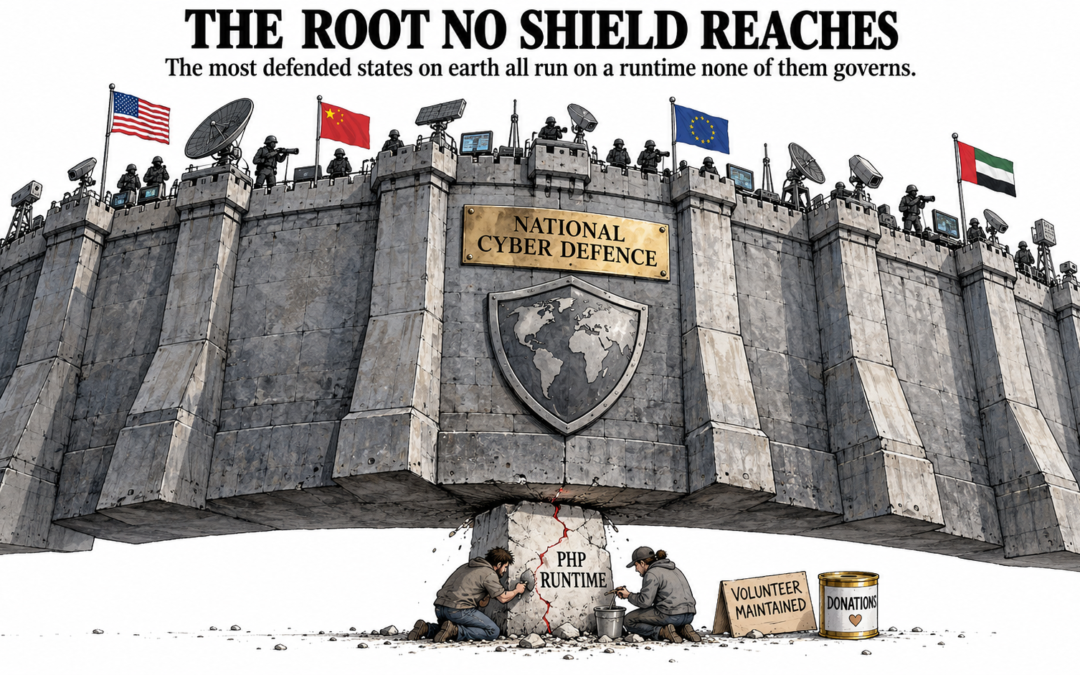
- Beneath all of it sits the finding no response touched: no sovereign governs the PHP runtime the whole world depends on, and the best shield on earth defends the surface, not the root.
Introduction
For one afternoon the world ran the same experiment on every government at once. Two remote code execution flaws in the PHP interpreter, the software behind roughly seventy per cent of the public web, were disclosed on the same day to every jurisdiction, with the same install base exposed and the same patch arriving from the same volunteers. The threat was held constant across all of them, so what the event actually tested was the response, and the response was misread almost immediately.
Most coverage equated the visible European shutdowns with the serious reaction and the silence elsewhere with incapacity. That reading rests on an assumption worth naming, because removing it is the point of this piece: that the loudest reaction is the strongest one, and that a government going dark in public is demonstrating control.
Apply instead the single test that treats every actor on the same terms, and the picture inverts. That test measures one thing only, whether citizens kept access to their services and whether the risk was managed. Judged that way, the states that stayed online managed the event and the states that went dark did not.
What made the difference was apparatus, and behind apparatus, doctrine. A government with continuous monitoring and the capacity to filter at the edge could see what was reaching it and decide proportionately. A blind government had two moves only, accept the risk and stay up, or switch everything off and wait. The first kind of state had a range of options; the second had a single switch.
The deepest reading levels of all of them. Ranked by what any government could actually do about the runtime, the ranking is flat, because every one of them depended on code it did not write, could not fix, and was never consulted on. The visible gradient of responses measures not sovereignty but how gracefully each state could ride a dependency none of them controlled.
The flaw everyone shared
The exposure was identical, which is what makes the comparison fair rather than anecdotal. Two flaws in the PHP core, CVE-2026-109618 and CVE-2026-109619, both rated CVSS 9.2 and both exploitable without authentication, put every government that runs PHP in the same position in the same hour.
This is not a story about one application or one framework but about the layer underneath them all, the interpreter itself, and about who controls that layer when it breaks. Two distinctions run through everything that follows: the shield is how a state defends what it runs, and the root is who governs what it runs on.
The vulnerability and the blast radius
Scale is why the event was global and simultaneous. On the most common configuration, Apache with the mod_php module, the first flaw can be triggered by an unauthenticated request before any application code runs, which leaves conventional application-layer defences with little to inspect.
The exposed surface was vast: scans put the number of internet-facing hosts advertising PHP at roughly 2.24 million, of which the hosts reporting a version showed 883,717 running branches that will never receive an official release. The only complete remedy was the patch, and every interim measure reduced exposure on some paths while leaving others open.
The damage record this early is a mix of the proven and the still-emerging, and precision matters here because this is where a reader checks the work. The data-capture capability is proven: the researchers who found the flaw demonstrated that the memory-disclosure path can read passwords, tokens, API keys and certificates belonging to other requests. Exploitation in the wild is confirmed, with attempts logged before public disclosure, and at least one operator has reported an intrusion it attributed to the flaw.
Confirmed named data losses lag exploitation by weeks in events like this, so their current absence from the public record is expected rather than reassuring. The outages, by contrast, are fully documented, and they are themselves the damage, not a precaution against it.
None of this describes a flaw whose danger was overstated. A pre-authentication route to the credentials of other live requests, exploited in the wild before it was even disclosed, sits at the ceiling of this severity class, not at its margin.
The room no sovereign was in
The first sign of where control actually sits appeared before the patch did. Disclosure ran through a defined circle: the PHP Foundation and its contractor, the research partners who found and confirmed the flaws, and the distributors given the fix early to build their packages.
One distributor shipped fixed images roughly six hours ahead of the agreed time, which pulled the schedule forward and reset the risk clock for everyone. One large cloud provider had separately logged an exploitation attempt four days before public disclosure, and another reported thousands of attempts hours before the patch shipped.
The composition of that circle is the point, and it applies to everyone equally. It held private companies and a volunteer foundation, and no sovereign government of any kind, not the United States government whose private firms were the gatekeepers, and not any other state. The knowledge that would let a government pre-position its defences, and the decision about when the clock started, sat with private actors. Whoever operates the pipes and runs the disclosure holds the timeline, and no national capability, however large, bought a seat at that table.
The gradient was not what it looked like
Reorganise the responses around the variable that actually separated them and the apparent hierarchy dissolves.
The question was never seriousness; it was whether a state could run a calibrated risk assessment at all.
With the apparatus to do so, a government saw what was reaching it, filtered the obvious exploitation, and kept its services running, which left nothing to announce. Without it, the state was blind, and the only safe move for the blind is to assume the worst and pull the plug.
The evidence that this turns on apparatus and doctrine rather than raw capability is direct. The ITU Global Cybersecurity Index for 2024 places the European states that shut down and the Gulf and Asian states that stayed online in the same top tier. That counts for less than it looks, because the index scores commitment, the laws, the national response team, the published strategy, the cooperation agreements, and not operational performance under live fire.
A top-tier rating and a shutdown are therefore not a contradiction; they measure different things, and the event is what exposed the distance between them. Two states rated equal on commitment behaved in opposite ways, so the variable that decided the day was not the one the index captures. It was doctrine: whether a state's apparatus is built to filter and hold, or to shut down and report.
Forced into the binary
The European response was the clearest case of the binary, and it should be read for what it reveals about doctrine rather than competence. In the Netherlands, the national cyber security centre took its own website offline, and the national authentication system DigiD, the citizen portal MijnOverheid, the parliament, the data protection authority and a platform serving more than a hundred municipalities all went down. Finland's state ICT centre took central government web services offline. Each measure was precautionary, not a response to a confirmed breach.
This has to be stated precisely, because the easy version of it is wrong. Europe did not go dark for want of capability; the Dutch national centre is among the most capable in the world. What it lacked was an anticipatory architecture. Its doctrine is oriented towards precaution and compliance, patch or take the system offline and report within the deadline, which reads as a reactive design, built to respond to a novel threat by shutting down rather than to absorb it.
The service mix compounded that. An authentication system and a citizen portal cannot block the vulnerable traffic without breaking their own function, so for the services that matter most to a citizen there was no mitigation path short of the plug, a constraint the event did not let anyone cleanly separate from doctrine.
Taking a national identity system offline is not a demonstration of control; it is the floor of sovereignty, the one move a state always holds, reached for when the others are gone. DigiD authenticates around 16.5 million people and processed more than half a billion sign-ins in a single recent year, which is the measure of what that last resort costs when it is used.
Calibrated, and quiet
The states that assessed and stayed online span several regions and two communication choices, and the distinction between those choices is not a distinction in capability.
One group paired capability with public guidance. The United States issued alerts through its civilian, law-enforcement and signals agencies. Japan's technical agencies published advisories and the prime minister urged operators to act, while the government stopped short of ordering shutdowns and the pauses that occurred were private-sector decisions. India's national CERT issued a critical-rated advisory, Singapore's cyber agency published an alert, South Korea raised its national alert level, and the national authorities of Saudi Arabia and Kuwait issued their own warnings.
A second group paired capability with silence. The United Arab Emirates issued no public national advisory and took nothing offline, and China issued no visible public mandate and took nothing offline. Publishing guidance and staying silent are two styles of the same capable response, not two levels of competence, and neither is the baseline from which the other departs.
Russia is the instructive edge of this group rather than an exception to it: more than ninety per cent of Russian-language sites run on PHP, the highest exposure of any major country, and the documented response was private precaution by hosting providers and individual sites, with no state shutdown and no national mandate. The highest stakes in the world, handled without panic and without a public lever, read on exactly the same terms as any other capable state's quiet.
Three kinds of silence
Description has to become judgement here, because silence meant three different things depending on who was quiet and why. One silence comes from a state whose apparatus saw the threat and handled it, and that is strength. A second comes from a state that neither saw the threat nor warned its operators, and that is negligence.
A third is harder to place at a glance, though the record behind it tells it apart. It comes from a state that saw its exposure clearly and stayed online anyway, not on proven capacity but because it could not risk a shutdown it might not reverse, and that is fear. The standard that separates the three applies to every state regardless of wealth or region, which is the neutral move rather than the generous one, and excusing any of them because of where it sits would be the condescension.
The distinction is functional rather than a matter of disclosure style. No state is culpable for being unable to afford a national monitoring operation. The negligence lies in leaving your own systems exposed with neither the capacity to protect them nor an alert for your operators to protect themselves, which is a breach of a universal duty of care to your own infrastructure. One silence follows an assessment and a defended perimeter; the other replaces both with nothing.
Silence from capability
The capable-quiet made an informed choice not to announce because the work was already done. What is observable is that their services stayed up and they raised no alarm.
That is the signature of an apparatus that saw the threat and handled it, because the competing explanations fit the facts worse: a blind state in that position goes dark, and the quiet of a breached one rarely survives contact with its own users. Read against the alternatives, their silence is the sound of an apparatus absorbing a shock it was built to absorb, and it is the posture the rest of the world should read as the strong response, not the European shutdown. It is also the category examined in detail in the next section, through its single clearest example.
Silence from negligence
The other silence belongs to states where no publicly visible national response appeared and where the capacity to mount one was absent. The dependency there is not in doubt and is worth showing rather than asserting.
Across official government websites, roughly fifty-eight per cent of South American sites run on PHP-based content management systems, about thirty-three per cent on Drupal and twenty-five per cent on WordPress, and in Africa the combined figure is about forty-one and a half per cent. The capacity gap is documented in the same ITU index cited earlier, which places numerous states across these regions in its lowest tiers.
The phrasing is deliberate throughout: no publicly visible response, not proven inaction, because an advisory on a closed channel or in a language the record did not capture would change the verdict for that specific state.
The charge is made at the level of the pattern, a government running critical public services on a stack it does not monitor and issuing no warning when that stack breaks, and the verdict falls wherever the evidence shows systems left exposed and uninformed, not on any region by character. These are among the most PHP-dependent and least resourced states, which is why the exposure concentrates precisely where the capacity to answer it is thinnest.
Silence from fear
The third silence looks, for a moment, like the first, because it also stays online and says nothing. What separates them is not the posture on the day but the record behind it. A state that absorbs attacks at scale as its standing daily norm is staying up on proven capacity, and that is preparation, to its full credit. The fear tier is the opposite case, a state with no such record that stayed online anyway, because it could not trust its own recovery enough to pull the plug.
Pulling the plug is only an option for a government confident it can restore on its own terms, and one without a tested path back fears the shutdown more than the breach. So it stays up and hopes, which is not courage but the absence of a safe alternative.
This is why the demonstrated defenders are not in this tier and should never be read into it: where a track record of absorbing attacks exists, staying up is the norm, not a gamble. The fear tier is defined by the absence of that record, a state exposed and unproven that stayed online because going dark frightened it more. The same logic that made shutdown the floor of sovereignty guarantees the case exists wherever recovery is not assured.
The UAE and the limits of a shield
Take the clearest single example of the capable-quiet tier and the structure of the whole argument becomes visible at once. The United Arab Emirates (UAE) is, on the available evidence, among the best-defended states in the world against this class of event, and through PHP2Shell it issued no advisory and took nothing offline, consistent with an apparatus that had assessed its exposure and had no need to retreat. That is worth examining closely, because the same example that shows what a world-class shield can do also shows exactly where a shield stops.
Nine years of building ahead
The UAE's cyber authority reports blocking on the order of 600,000 attacks a day against the country's vital public and private sectors, with energy and aviation among the most targeted. The figure measures the national perimeter and its sectors rather than any single application, and stated with that scope it is a robust and verifiable fact, because a system that absorbs that volume as its standing daily state is demonstrating proven capacity under sustained adversarial load.
Paired with the country's top-tier commitment rating in the same ITU index, that operational record is the combination the shutdown states lacked, frameworks matched by the apparatus to run them, and it places the UAE among the most capable defenders anywhere.
What produced that capacity is doctrine sustained over time rather than a reaction to this event. It is the result of years of continuous, anticipatory building, infrastructure and monitoring stood up ahead of the threats and loads they would eventually meet rather than after they arrived. That is the difference between the proactive and the reactive posture, and the evidence for it is the nine-year record and the standing it produced, not the state's account of itself. That account happens to match.
Speaking at the AIM Summit in Dubai on 10 October 2026, the country's Minister of AI, H.E. Omar bin Sultan Al Olama, put the governing principle plainly, that governments 'can't afford to react' and that a rule written only after the catastrophe arrives too late to prevent it. Coming from the state about itself, that corroborates the posture rather than proving it, but the principle it states, building ahead of the threat rather than after it, is the same one that stands a defence up before the flaw that tests it, which is why a novel bug was met with management rather than scramble.
No one predicted this particular bug, the UAE included. What was already in place was an apparatus built to carry whatever arrives, so an unforeseen shock was, in operational terms, another day's load to a system built to absorb load. Capacity built ahead of need carries headroom for the next threat and the next volume; capacity built to current demand does not.
What the shield cannot reach
Now the limit, and it is not a limit of the UAE but of a shield. The UAE's defence, however robust, runs on a runtime it does not govern, on a disclosure timeline it was not part of, and on defensive tooling that largely originates in another jurisdiction.
The 600,000 figure measures the withstanding of attacks, which the country unquestionably does, and it does not measure control of the PHP interpreter, because nothing at the national perimeter touches the interpreter. The most capable defender in this story could no more change a line of the runtime, or the timing of its fix, than the least capable one.
The shield therefore frames the country's position as an opportunity rather than a shortcoming: the UAE has mastered every layer its own building can reach, and the one layer it has not reached, the substrate itself, is the next frontier.
This is where competence carries its own risk, and the risk is universal rather than specific to any state. The better a shield works, the easier it becomes to mistake a managed dependency for a sovereign one, because the defences are good enough that the root never forces itself into view. A state that has gone dark cannot pretend it governs the runtime, while a state whose shield held can, and that quiet confidence is the more dangerous condition precisely because it lands on the capable rather than the exposed.
The root no shield reaches
The root cause is global, and no national shield at any level of excellence can fix it. The root is a runtime that most of the world depends on and that no sovereign funds adequately, governs, audits, can fix, or sits in the room for when its disclosure is timed. That is not a problem a single state can solve by building, and the reason is structural rather than a failure of will.
PHP is a global commons, so if any one government funded and governed it tomorrow, it would not gain sovereignty over it; it would hand the whole world a slightly better-maintained dependency and capture almost none of the benefit itself.
So every actor builds its own shield, which it can keep, and none builds the root, which it could not. The security gap that remains is a collective-action failure sitting on top of a commons, not a technology gap, and saying so is what separates this from the familiar call to simply fund open source.
That cross-border technical risk defeats national-only action is not a fringe reading, it is how those governing frontier technology already speak. At the same summit, the UAE's AI minister made the point about rogue AI, that regulation 'isn't global, it means nothing' against an agent that can go rogue in one country and reach into systems in another, and the runtime is the same problem one layer down, a shared dependency whose failures cross every border in the same hour.
The ungoverned substrate
Reassemble the stack the event exposed and the distribution of control is plain. The runtime answers only to its maintainers, the disclosure timeline to the private firms inside the circle, the defensive tooling to a small set of vendors, and the distribution of the fix to volunteer packagers, one of whose primary channels had nothing ready on patch day. The single decision to go offline is the only layer in the chain a state actually controls, which is why shutdown looked like the serious response. It was the one move inside sovereign hands.
A reader could object that a controlled shutdown is itself an act of sovereignty, the state throwing the one lever it fully owns, and that staying online is the real gamble. Half of that holds. Staying up is not automatically the strong move, since a state can stay up on an apparatus that held or stay up in ignorance of its own exposure, and only the first is strength.
The other half breaks on what sovereignty actually requires. A kill switch is sovereign only if the state also controls when the service comes back, and none of those that went dark did. They restored, but only when the external patch arrived, on a clock set by the same volunteer packagers and disclosure timeline that no state controlled.
A government can pull its own plug on its own authority; it cannot choose the hour of its own recovery, because coming back safely was gated by actors outside it. A lever you can throw but cannot choose when to reverse is the dependency made visible at the worst possible moment, the one when you are trying to recover. That is why the shutdown is the floor: it is the move left when the power to stay up, and the power to set the terms of return, have both already passed out of sovereign hands.
All of this exposes both the shutdown and the attack-count for what they are. The shutdown performs seriousness and the 600,000-a-day figure performs strength, and each is real on its own terms while neither measures the one quantity that would be sovereignty, the ability to fix the thing you depend on. On that single axis the result is uniform: neither the United States nor China, neither Europe nor the UAE, controls the PHP runtime, and no one is sovereign over the substrate.
The visible gradient of responses, from loud shutdown through quiet management to exposed silence, measures not sovereignty but how each state staged a powerlessness they all shared. The exclusion runs to the top, because the bodies that do govern the runtime are funded and steered by a handful of corporations and one European state fund, with no dependent sovereign, capable or not, among them.
A class, not an anomaly
PHP2Shell is not a freak event, and reading it as one misses the pattern it belongs to. The same structure produced Heartbleed in 2014, which exposed OpenSSL and prompted the first coordinated effort to fund critical infrastructure code, and the XZ Utils backdoor in 2024, which rode a single exhausted volunteer maintainer to the edge of a global supply-chain compromise.
Log4Shell in 2021 was the same worldwide scramble over a dependency almost no one had chosen deliberately, and the global outage caused by a single vendor's faulty update in 2024 was the proprietary mirror of the same concentration risk, which is licence-blind. The interval between these events is also narrowing, seven years from Heartbleed to Log4Shell, three to the XZ backdoor, two to PHP2Shell, and discovery is accelerating as automated methods compress timelines that once took human auditors years, so the direction is not in doubt even if the exact spacing is: more of these are coming, not fewer.
The response gradient re-runs every time one of these breaks, because the dependency structure underneath it has not changed. This is the survivability condition failing in public: dependence on a system no actor can refuse and still operate.
The Bottom Line
The world read PHP2Shell as a test of seriousness, and it was a test of apparatus and doctrine. The states that had built the capacity to assess and filter stayed online and said little, while the states without it shut down or went silent and exposed, and that silence meant three different things, competence, negligence, or fear of a shutdown that could not be reversed, measured against one standard applied to all.
The United Arab Emirates proved that building ahead works, that nine years of anticipatory capacity can meet an unforeseen shock with management rather than panic, and the same example proved the limit, because the best shield in the world still cannot reach a root that is global, ungoverned, and outside every sovereign's grasp.
No one governs the runtime the whole world runs on, and the room that could govern it holds none of the states that depend on it. So the question the event leaves is not who responded best on the day but who is positioned to make the substrate itself secure, and why, nine years and several of these events in, it is still no one who runs on it.
#DigitalSovereignty #PHP2Shell #CyberSecurity #OpenSource #DigitalPublicInfrastructure