TL;DR
- The $6.36 billion theft from Binance on 29 October 2026 is the largest cryptocurrency theft on record, drained across ten blockchains in under twenty minutes from a compromised DevOps endpoint, the first of several breach points investigators later identified.
- Attribution came first from Chainalysis and TRM Labs, private firms deriving majority revenue from US government contracts, and then from the FBI, which named North Korea's TraderTraitor operation two days after the breach. Official attribution identifies the attacker. It does not audit the vault.
- The custody architecture lacked velocity caps, circuit breakers, signing quorums, and chain-level key segregation, the controls underwriters require, and the loss exceeded the entire crypto-insurance market's capacity many times over.
- The political economy connecting a presidential pardon, $1.4 billion in crypto income, a $2 billion sovereign investment routed through the president's family stablecoin, and extrajudicial stablecoin freezes of roughly $2.5 billion forms a closed loop that the North Korean attribution conveniently obscures.
- The attribution industry's structure mirrors pre-2008 credit rating agencies across six dimensions: oligopolistic, quasi-governmental, methodology-opaque, accountability-free, revenue-aligned with the threat it diagnoses, and providing assurance without liability. None of this is visible while the left hand waves North Korea.
Introduction
On 29 October 2026, $6.36 billion moved across ten blockchains in under twenty minutes. The initial entry point was a compromised DevOps laptop that reached the service container handling withdrawal requests; Binance later said investigators had found additional breach points.
Eleven separate hot wallet keys signed transfers within a twelve-minute window across chains requiring different cryptographic signing schemes, ruling out any single key leak.
The numbers arrived first. The attribution arrived second, from Chainalysis and TRM Labs within hours and from the FBI within two days, each naming North Korea's TraderTraitor operation. The custody architecture arrived last, if it arrived at all.
That sequence is a pattern, not an accident. Every major hack with immediate state-actor attribution has produced reduced corporate accountability. SolarWinds: Russia attributed within days, no executive departed, CISA's budget expanded. Colonial Pipeline: Russia-linked attribution within hours, no structural reform of pipeline cybersecurity mandated.
The control case is Equifax: no state-actor attribution, CEO resignation within 59 days, a $700 million FTC settlement, and the US House Committee calling the breach "entirely preventable." The only major breach where the institution bore the full weight was the one where nobody blamed a nation-state.
The North Korean attribution of the Binance hack functions as a distraction mechanism regardless of its accuracy or its source. It does not need to be wrong, or unofficial, to serve that purpose.
It only needs to arrive first and absorb the analytical oxygen that would otherwise flow toward the custody architecture, the political economy, and the stablecoin sovereignty crisis that this hack exposed.
The left hand is what the audience is being shown. This article examines the right hand. The threat rotation pattern was first documented in The Boogeyman Rotation, where the cycle of shifting attribution targets to serve institutional purposes was established as a structural feature, not a conspiracy.
How the Signing Layer Drained Ten Blockchains
On the account pieced together by TRM and Halborn, pending any root-cause disclosure from Binance, the attack did not begin with key theft. It began upstream, at the signing service container sitting between DevOps infrastructure and every individual signer on every chain Binance operated.
A compromised DevOps laptop reached that container, and Binance later said investigators found further breach points beyond it. From there, the attacker did not need individual keys; it held the infrastructure that controlled all of them. More than one way in makes the concentration at the signing layer worse, not better.
Eleven hot wallet keys signed transfers within twelve minutes. Bitcoin (18,270 BTC), Tron ($628 million), XRP ($300 million), and Solana ($96 million) each required different signing schemes: secp256k1 for Bitcoin, ed25519 for Solana.
The cryptographic diversity rules out a single leaked key and points instead to the signing service approving transactions without validating them, the blind-signing failure that has recurred across exchange hacks.
On Ethereum, 50 pre-signed EIP-7702 authorisations covering consecutive nonces persisted for three hours and fifty minutes. Wintermute's analysis found the overwhelming majority of EIP-7702 delegations were malicious.
The EIP-7702 delegation risk had been flagged publicly for months before the theft, with no mitigation from the Ethereum Foundation.
The replenishment failure turned a breach into a catastrophe. Binance's automated pipeline pushed 200 million USDT into the compromised wallet eighty minutes after the initial drain began. Anomaly detection was not connected to the replenishment system. A second wave of drains hit Avalanche and Polygon thirty minutes after Binance paused withdrawals on other chains.
The Architecture That No Regulator Would Permit
On the evidence published so far, the architecture had no velocity caps, no circuit breakers, no quorum-based signing, no chain-level key segregation, and no delegation monitoring. SWIFT's Customer Security Programme mandates 22 controls for messaging infrastructure alone. Japan mandates 95% cold storage for exchange assets. Hong Kong mandates 98%.
Institutional custodians such as Fireblocks and BitGo enforce multi-party computation quorums and velocity limits as baseline requirements. Binance holds no MiCA licence in the European Union. Christine Lagarde blocked the Greek licence application. France prohibited Binance from providing crypto services as of July 2026.
Binance carried no third-party cyber insurance. The SAFU fund held approximately $1.27 billion in Bitcoin, a correlated asset that was never independently audited, set against a $6.3 billion loss. Total global crypto insurance capacity sits at approximately $1 billion.
The largest single policy ever written, by Marsh, covered $825 million, or 13% of this loss. Even insured to the market's limit, Binance could not have covered a loss of this size, and the controls underwriters require were the ones it lacked.
Binance has since said it reserved more than $6.34 billion of company funds and covered roughly 90% of the losses. That a company can absorb a $6.3 billion loss from its own balance sheet measures its scale, not its controls. Financial remediation and sound architecture are separate tests, and only the first has been met.
No external attestation of reserves had been conducted since Mazars departed in December 2022. The 1 October proof-of-reserves report listed $1.26 billion in USDT and 89,475 ETH in wallets that were exploited twenty-eight days later.
Who Attributed and Why It Matters
The FBI attributed the theft to North Korea's TraderTraitor operation on 31 October, two days after the breach, and asked the DeFi community to block the associated addresses. It had taken the FBI five days to issue a comparable attribution for the Bybit theft; for Binance, more than four times larger, it moved faster.
Official attribution arrived quickly. A complete, independently reproducible forensic case did not, and naming the attacker does not establish that Binance's custody controls met any standard.
Later the same day, President Trump said the United States had not confirmed North Korea's involvement, declining to endorse his own FBI's finding. The official account is not even internally unified.
The attribution came first, and loudest, from two private firms with direct revenue interests in the threat narrative. Chainalysis holds approximately $190 million in annual recurring revenue, the majority from government contracts across the FBI, Treasury, and IRS. Its valuation has fallen from a peak of $8.6 billion to around $2.5 billion.
TRM Labs carries a $2 billion valuation on the back of a $94.6 million sole-source ICE contract that Chainalysis is now challenging in court. The two firms litigate contract allocation while jointly producing the threat narrative that justifies the contracts.
The revolving door between government and the attribution industry runs in one direction. IRS Criminal Investigation chief Jim Lee moved to Chainalysis in April 2024. FBI Assistant Director Gurvais Grigg moved to Chainalysis. Senior Treasury and OFAC adviser Ari Redbord moved to TRM Labs.
TRM Labs now attributes 76% of all 2026 crypto hack losses to North Korea, a share that has climbed steeply as the firm's government revenue has grown. The trajectory tracks commercial dependency as much as threat evolution.
South Korean media coverage of the Binance hack is analytically significant for what it does not contain. Despite South Korea having the most direct intelligence interest in North Korean cyber operations of any country, Korean-language security coverage sources exclusively from Western blockchain analytics firms, quotes no Korean security researchers, and describes no forensic methodology.
The country with the strongest reason to produce independent attribution analysis produces none.
The Accuracy Nobody Has Tested
Ghost Clusters, published at USENIX Security 2025 by Delft University researchers, is the only peer-reviewed evaluation of blockchain attribution tools. It found accuracy ranging from 24.54% to 94.85% depending on methodology. The range is so wide it encompasses coin-flip territory at the lower bound.
Chainalysis's head of investigations stated under oath that she was "unaware" of scientific evidence proving Reactor's accuracy and confirmed the firm does not track false positives. Its headline North Korea figures, such as 89% of all 2026 hacking losses, are self-published estimates that no external body audits.
In the Bitcoin Fog trial, an approximately 64% accuracy discrepancy emerged between Chainalysis's claimed tracing and independently reconstructed fund flows; the defence expert described the methodology as "unverifiable."
In the Tornado Cash prosecution, the reliability of Chainalysis's tracing was contested in open court, and the government that funds the tool kept its case at arm's length from the firm's analysis.
The laundering behaviour complicates the "same actor" thesis connecting Bybit and Binance, even as TRM points to similarities in how the two attacks were prepared.
The Bybit theft showed methodical CoinJoin mixing over weeks, consistent with patient state-actor tradecraft. The Binance theft shows DeFi lending positions and panic selling at 12% to 26% below market value, consistent with urgency. The divergence is evidence that calls for explanation, not by itself proof of a different actor.
Elliptic, itself a blockchain analytics firm with a commercial position in the attribution industry it is commenting on, noted that shared address overlap amounts to $39,000 and "could reflect a launderer serving several clients, not necessarily the same hacker."
A CoinDesk Korea investigation quoted an unnamed crypto investigations insider noting that North Korean groups "usually move and launder stolen funds much faster and more skillfully" than the Binance attackers did.
The capability paradox resolves through distributed operations across Shenyang, Khasan, Cambodia, and Russian TransTelecom AS20485 infrastructure. Russia vetoed the UN Panel of Experts monitoring North Korean sanctions in March 2024, collapsing the independent verification mechanism.
The capability exists, but the attribution to North Korea specifically, rather than to a broader Russia-enabled operational infrastructure, is an analytical choice, not a forensic conclusion.
What International Law Actually Requires
The International Court of Justice has required, for grave claims of state responsibility, evidence leaving "no room for reasonable doubt" (Corfu Channel, 1949) and proof that is "fully conclusive" (Bosnian Genocide, 2007). No agreed evidentiary standard governs public cyber attribution, but against the closest analogues international law offers, a law-enforcement naming falls short of both.
Under the Tallinn Manual on international law applicable to cyber operations, a state that takes countermeasures on a mistaken attribution risks committing an internationally wrongful act of its own, which places the burden of getting attribution right on the state that acts on it.
The 2015 UN Group of Governmental Experts agreed states should substantiate public accusations of cyber operations but left the evidentiary bar undefined. Private firms whose revenue depends on the attributions they produce now occupy that gap.
Non-Western analysis frames attribution differently. China's stated position is that technical attribution is "nearly impossible" and public attribution is "counterproductive." The Observer Research Foundation characterises cyber attribution as "a strategic choice tied to geopolitical goals, not a neutral technical finding."
RUSI's 2025 assessment notes that Global South states view attribution as a "declaratory tool" and observes that Western attribution coalitions have "largely faltered." No industry-wide attribution standard exists, by TRM Labs' own acknowledgement.
The Credit Rating Agency Precedent
The structural parallel to pre-2008 credit rating agencies is precise across six dimensions. Oligopolistic market structure: two firms dominate blockchain attribution as Moody's and S&P dominated credit ratings. Quasi-governmental authority: attribution triggers sanctions and asset freezes, as investment-grade ratings triggered pension fund allocation mandates.
Methodology opacity: proprietary algorithms, unaudited, with no public error rate. Absence of accountability: no documented false positive rate, no liability for incorrect attribution. Revenue-threat alignment: revenue depends on the volume and severity of the threat the product identifies.
Assurance without liability: proof-of-reserves attestation parallels investment-grade ratings stamped on toxic mortgage-backed securities.
When Moody's and S&P rated structured products as investment-grade, pension funds bore the losses. When Chainalysis and TRM Labs attribute a theft to a sanctioned nation-state, that attribution triggers diplomatic consequences, sanctions enforcement, and asset freezes.
The post-2008 outcome is instructive. Settlements totalling $2.24 billion were paid; zero criminal prosecutions followed; no methodology transparency was imposed. The industry structure survived intact.
Public Citizen's data quantifies the enforcement gap at scale: 63% of companies under deferred prosecution agreements received additional DPAs, and only 1% of breaches were punished. The blockchain attribution industry sits at an earlier point on the same trajectory, with even less oversight and no legal liability for incorrect attributions.
The Pardon-to-Profit Pipeline
Changpeng Zhao pleaded guilty in November 2023 to Bank Secrecy Act violations that were real and documented. Binance processed transactions for sanctioned entities, operated without adequate anti-money-laundering controls, and the $4.3 billion settlement reflected genuine regulatory failure. This is not in dispute.
The full unconditional pardon came on 23 October 2025. No conditions were stated. The White House cited Biden-era "egregious over-sentencing." Zhao changed his X profile from "ex-@Binance" to "@Binance" and floated a refund of the $4.3 billion criminal fine.
The pardon did not erase the underlying conduct; it removed the consequences of a legitimate conviction, which makes the compliance collapse documented below worse, not better, because the enforcement mechanism designed to prevent exactly this failure was politically dismantled.
Donald Trump disclosed $1.4 billion in cryptocurrency income in 2026, holding approximately 60% equity in World Liberty Financial through DT Marks DEFI LLC with a 75% net revenue share. Cryptocurrency is his largest single source of wealth.
MGX invested $2 billion in Binance via USD1, the stablecoin issued by World Liberty Financial, with a 49% stake sale to Sheikh Tahnoon's entities following. Steve Witkoff, who backed the UAE chip deal, reported $107 million in income on his financial disclosure.
CBS 60 Minutes reported that "without Zhao, the technology wouldn't exist for World Liberty's crypto venture." The Department of Justice was scrutinising Binance's settlement compliance as recently as 9 October 2026, twenty days before the hack. The SEC simultaneously dropped its enforcement action against Binance.
The pardon, the $2 billion investment through the family stablecoin, the dropped SEC action, and the monitor-termination talks share both timing and parties. The same administration pardoned the founder and oversaw the company it was investigating. When the FBI named North Korea, the president who profits from the family stablecoin would not confirm his own Bureau's attribution of the theft.
Stablecoin Freezes as Sovereignty Events
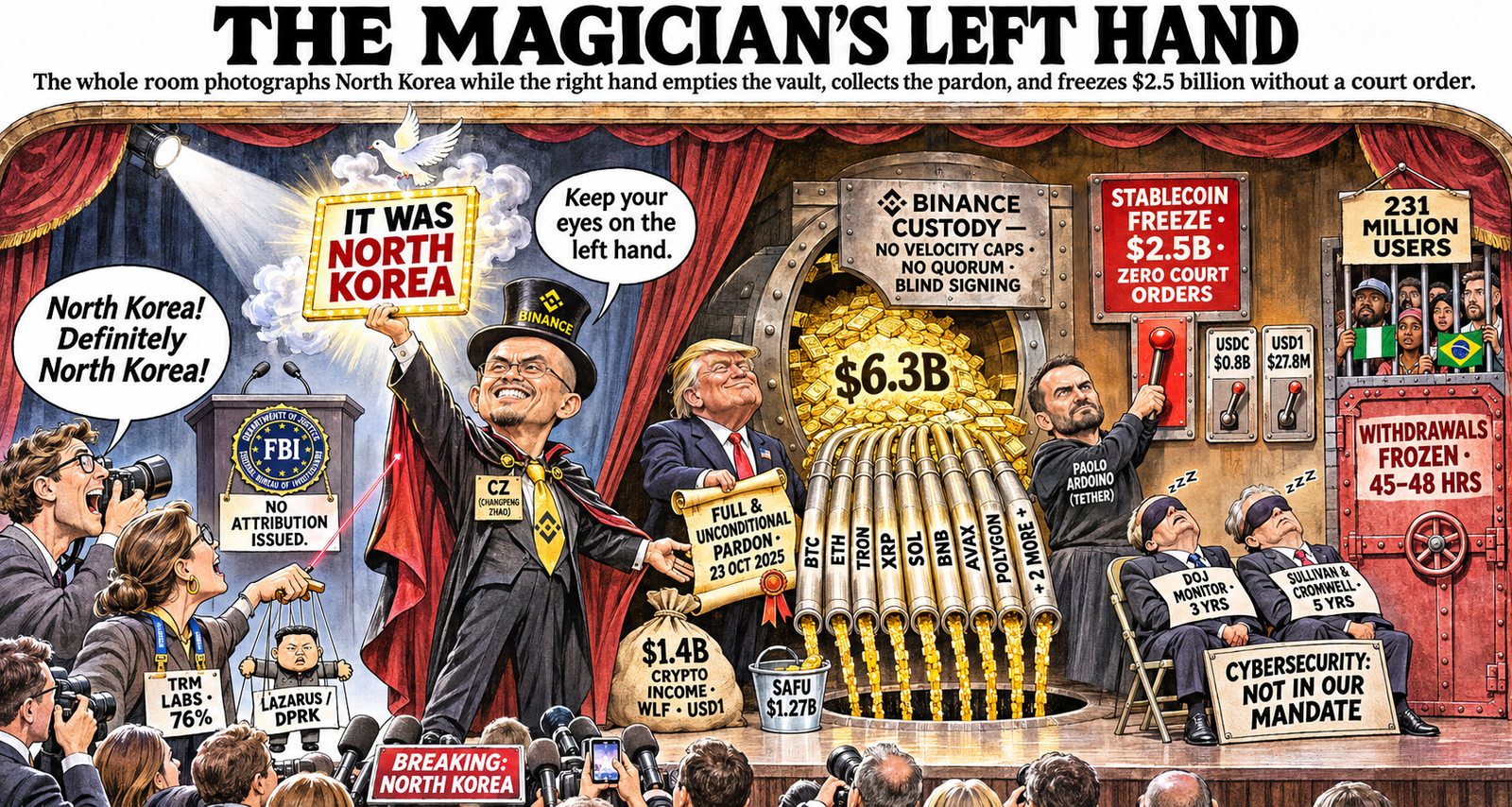
Tether froze more than $1.567 billion in USDT within 37 minutes, per CEO Paolo Ardoino. Circle froze more than $800 million in USDC minutes later. World Liberty Financial froze a further $27.8 million in USD1 with no cited legal basis. Binance verified roughly $2.5 billion frozen across the issuers, about 40% of the stolen funds, executed with zero court orders.
Tether's terms of service permit freezes "in its sole discretion" when deemed "prudent." Tether had frozen more than $4.9 billion cumulatively before this freeze, and rarely reverses one. Circle contradicted its own stated court-order-only policy. New York prosecutors allege Circle earns interest on frozen reserves.
Binance invested $100 million in Circle thirty-seven days before the hack. The jurisdictions most affected by stablecoin freezes are building legal frameworks that challenge the practice, though those frameworks carry no extraterritorial reach.
Nigeria's Court of Appeal ruled in 2025 that banks cannot freeze assets on law enforcement directive alone. A Thai lawsuit documented a freeze in October 2025 with the warrant arriving 112 days later.
The People's Bank of China classifies stablecoins as illegal virtual currency. Its November 2025 coordination meeting identified five explicit sovereignty threats: challenge to currency issuance authority, currency substitution risk, weakening of monetary policy transmission, bypass of capital controls, and extension of US extraterritorial jurisdiction via dollar-denominated stablecoins.
Former PBOC Governor Zhou Xiaochuan has linked high cross-border payment costs directly to "balance of payments, exchange rates, and currency sovereignty." China's February 2026 eight-department joint notice banned offshore RMB-pegged stablecoins without PBOC approval, asserting sovereignty over extraterritorial token issuance.
This mirrors the US GENIUS Act's restrictions on foreign issuers from the opposite direction. SUERF, the European Money and Finance Forum, frames dollar stablecoins as instruments of US extraterritorial financial control.
Both the Chinese and European assessments are analytically correct and strategically motivated, since China is simultaneously competing via the digital yuan; acknowledging the competing interest does not weaken the structural observation. The GENIUS Act is silent on voluntary freezes. The CLARITY Act would retroactively legalise them.
The statutory framework for a freeze on this scale remains unwritten.
The Monitors That Were Not Watching
Binance operates under dual monitoring: a Federal Resiliency Auditor appointed by the DOJ in May 2024 for three years, and Sullivan & Cromwell appointed by FinCEN for five years. Neither mandate covers cybersecurity, custody architecture, or key management.
The $6.3 billion failure occurred in the exact domain that both monitors were excluded from examining. A $150 million suspended penalty hangs on non-compliance, but no monitor report has been made public.
Binance entered "advanced, confidential negotiations" to end the DOJ monitor as of September 2025 and established a "dedicated monitor liaison office" to manage the relationship. Binance blocked Sullivan & Cromwell information requests.
The gap between what a monitorship promises and what it delivers is a documented institutional feature, not a Binance anomaly. The DOJ monitor has produced no public findings on the architecture that enabled the theft. Donoghue estimated a "ten-figure investment" would be needed for genuine compliance; the actual monitoring budget remains undisclosed.
Ford and Hess (2009) found monitorships are "significantly less ambitious" than their authorising documents suggest. Public Citizen's enforcement data confirms the pattern at scale: 63% of companies under deferred prosecution agreements received additional DPAs, and only 1% of breaches were punished.
The monitorship mechanism is not failing; it is functioning as designed, and the design prioritises institutional continuity over structural reform.
The Compliance Staff Who Knew
At least five investigators were reportedly fired in late 2025 after flagging $1.7 billion in Iran-linked transaction flows: Blessed Trust ($1.2 billion), Hexa Whale ($500 million), and transactions linked to Babak Zanjani ($850 million, OFAC-listed).
Several came from law enforcement backgrounds. Remaining staff reported "fear of legal repercussions," pointing to non-disclosure agreements or equivalent contractual silencing mechanisms.
Chief Compliance Officer Noah Perlman was reportedly planning his departure. Bloomberg confirmed a compliance staff exodus in April 2026. Senator Richard Blumenthal sent a congressional letter to CEO Richard Teng alleging "misrepresentations or misleading information" provided to Congress. The CFTC issued Notice of Covered Action 2023-034.
The pattern is consistent across every compliance function. The Iran transaction flows were not hidden; they were flagged, and the staff who flagged them were removed. The monitors whose mandate could have caught this were negotiating their own early termination. The whistleblower protections that exist on paper protected nobody who used them.
The Populations Who Pay
Seventy-seven percent of Binance's 300 million registered users are in emerging markets, approximately 231 million accounts. No deposit insurance applies. No lender of last resort exists. No regulatory framework for exchange failures covers most of these jurisdictions.
Binance imposed a blanket 45-to-48-hour withdrawal freeze with no geographic exemptions. Nigeria, with roughly $92 billion in annual crypto volume and most of it routed through peer-to-peer channels, lost access to primary financial infrastructure.
Brazil, where 90% of crypto volume is stablecoin-denominated, lost dollar-access mechanisms. No emerging market regulator issued a public statement: not Nigeria's SEC, not Brazil's CVM, not India's SEBI.
Abu Dhabi's FSRA was the only non-Western regulatory response, and it was procedural. The regulatory silence reflects a mix of capacity constraints, jurisdictional ambiguity, and in cases such as Nigeria, a deliberate choice to avoid accountability for domestic regulatory failure.
The Arbitrum Security Council modified the inbox contract, added a function called sendUnsignedTransactionOverride, impersonated the attacker address, and moved $30.5 million through a 9-of-12 multisig override. "Decentralised" infrastructure was overridden by centralised governance when the amount was large enough.
The freeze amounted to a bank holiday declared by a private foreign entity, imposed on populations with no alternative dollar-access mechanism and no regulator positioned to object.
Binance said it had covered about 95% of the losses from its own funds and had begun restoring withdrawals, Bitcoin first and other assets in phases. Independent attestation of the reserves behind those claims had not been published.
Whatever the final figure, the capability the episode exposed does not reset with the balances. A private operator priced emerging-market users out of their own funds for as long as it chose, and nothing structural prevents a repeat.
The accountability pattern is now empirically established. Bangladesh Bank's governor resigned within 39 days over an $81 million loss. Equifax's CEO resigned within 59 days, followed by a $700 million FTC fine.
Binance: zero leadership departures, active lobbying to remove monitors, the founder floating a refund of a criminal fine. No regulated bank has lost $6.3 billion to a single external compromise; the controls required of them, segregation, hard limits, deposit insurance, a lender of last resort, exist precisely to make a loss of this scale remote.
In cryptocurrency, the attacker is the story, the institution's negligence is a footnote, and the North Korean attribution ensures it stays that way.
The Bottom Line
The question "was it really North Korea?" is itself the distraction. The right question is why the answer determines whether Binance faces accountability for an architecture that no regulated financial institution on earth would be permitted to operate.
The attribution was produced first by firms with a documented revenue interest in the threat they diagnose, validated by no standards body, audited by no independent mechanism, and complicated by differences in the observed laundering behaviour.
The FBI has since named the same culprit. It is institutionally independent of Binance and of the firms, but its statement published conclusions and address lists, not a reproducible methodology, and the FBI is among Chainalysis's largest customers. An official judgment is not a reproducible one.
The structural parallel to pre-2008 credit rating agencies is not an analogy; it is a diagnosis.
The custody architecture failed every institutional standard: no velocity caps, no signing quorums, no circuit breakers, no chain-level key segregation. The replenishment system fed money into the compromised wallet after the drain started.
The proof-of-reserves report listed the exploited wallets twenty-eight days before they were drained. The exchange carried no third-party cover for a loss of this size, and self-insured with a correlated asset it never audited.
The monitors had no cybersecurity mandate. The compliance investigators were fired for doing their jobs. The legitimate criminal conviction that created the monitoring requirement was erased by a pardon from the president who profits directly from the company's stablecoin infrastructure.
Three private stablecoin issuers froze roughly $2.5 billion across global networks without a single court order, demonstrating the extraterritorial financial control that both Western researchers and competing sovereign monetary authorities have independently identified.
An estimated 231 million emerging-market accounts, a share of registered users rather than a count of people who attempted withdrawals, sat under the freeze with no regulatory voice, on an exchange whose custody controls no regulated banking system would permit.
The FBI has named the thief, the President has declined to endorse the naming, and Binance says it has replaced nearly all of the money. Each of these can be true, and none answers the question at the centre of this.
Why could a breach reach signing infrastructure across ten blockchains at once, why did automated replenishment keep feeding a drained wallet, and who independently judged the controls before they failed?
The magician's left hand waves North Korea. The right hand built an exchange with the custody controls of a spreadsheet, pardoned its convicted founder, fired the investigators who found the Iran flows, and froze stolen assets across global networks without judicial process.
The question is not who stole the money but why the architecture that lost it, the industry that attributed it, and the political economy that surrounds it are receiving less scrutiny than a country with 1,024 IP addresses.
#DigitalSovereignty #Binance #CryptoSecurity #CyberAttribution #FinancialRegulation