TL;DR
- Canada put $1.6 billion into Cohere and called it sovereign AI.
- Measured against a definition that can return a no, enforceable authority and practical control across capital, infrastructure, and revenue, the deal fails at every layer: governance rights undisclosed and, when asked directly, unanswered; compute on NVIDIA chips in an American-operated data centre; 85 to 90 percent of revenue foreign.
- On-premise does not save it: open-weight models deliver on-premise control for the cost of compute, and the United States has already shown it can cut a running deployment on American infrastructure by letter.
- The analyst who sold the deal as sovereign applied no test at all.
- A cheque and a label are not sovereignty, and every unexamined use of the word empties it further.
This one happened to be today
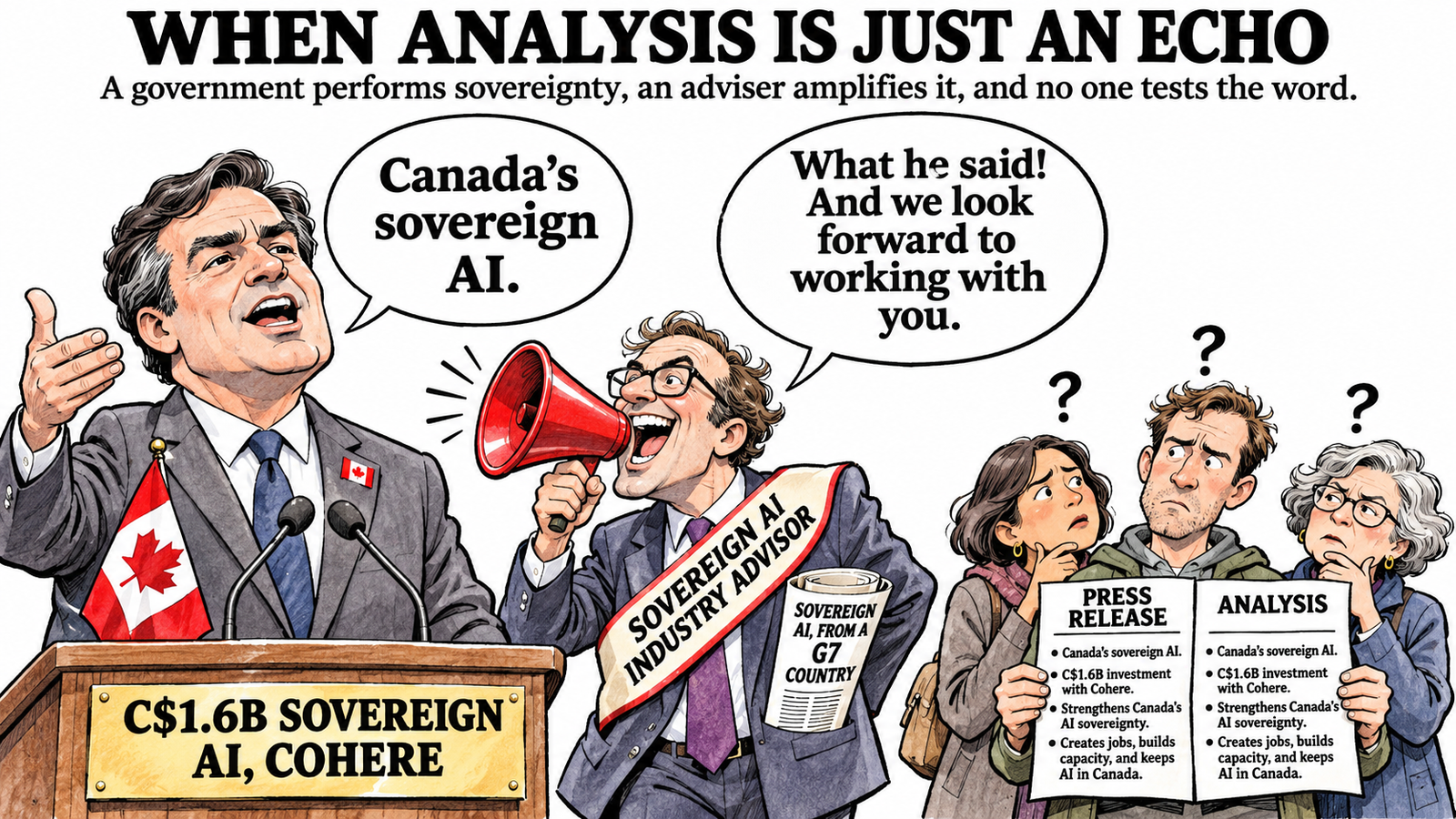
A newsletter article landed in my feed this morning announcing Canada's $1.6 billion equity investment in Cohere. It called the deal sovereign AI. The analyst who published it brands himself "Sovereign AI Industry Advisor" and describes his newsletter as "the world's first AI newsletter focused on sovereign AI from a G7 country for policy and decision makers."
I have chosen this article because it is a textbook case of a pattern that plays out routinely across every continent. Any sovereign AI announcement from any government, covered by any analyst, would have served the same purpose. This one happened to be today.
The pattern is simple.
- A government writes a cheque.
- A vendor attaches the word "sovereign."
- An analyst repeats it without testing it.
And the word empties itself one use at a time.
Carney defined the problem
What Canada is doing on sovereignty across multiple fronts is important, and the reason this particular failure matters is that Canada has earned the credibility to set the standard.
Mark Carney's Davos speech in January 2026 told the World Economic Forum that the old rules-based order is dead, that economic integration is being weaponised, and that middle powers must act to protect their sovereignty rather than perform it.
He drew a sharp line: accommodating a more powerful hegemony, he said, is not sovereignty but "the performance of sovereignty" while accepting subordination. That speech resonated globally. It accelerated sovereignty and digital sovereignty initiatives across dozens of countries with credibility and urgency.
Which is precisely why it matters when a specific deal carrying the sovereign label fails the standard that Canada itself articulated. If sovereignty can be performed without being delivered, the performance degrades the concept for everyone. Canada set the bar, and this deal needs to clear it.
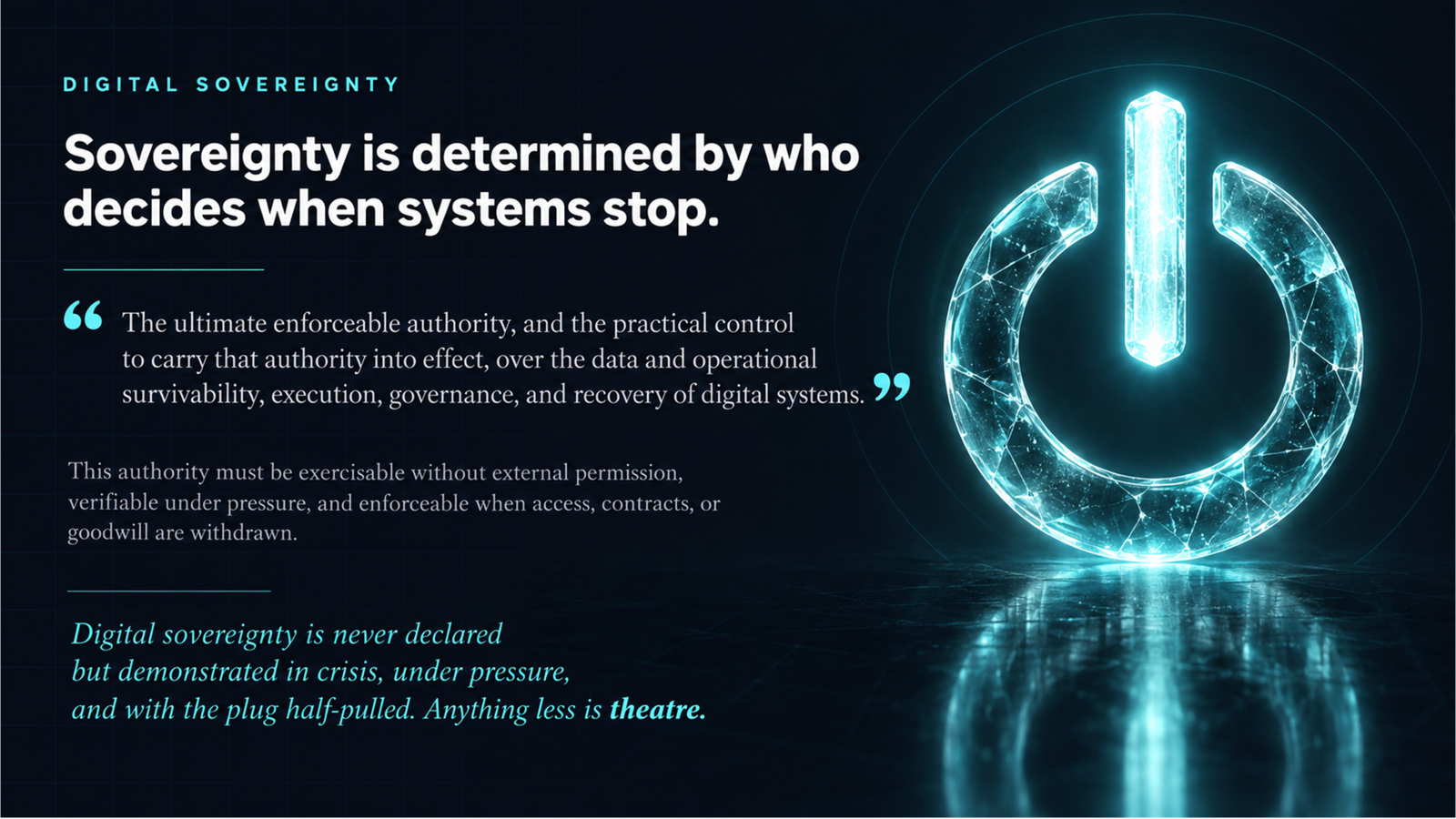
In The Digital Sovereignty Imperative, I define digital sovereignty as:
The ultimate enforceable authority, and the practical control to carry that authority into effect, of nations, organisations, communities, and individuals (collectively, the sovereign) over the data and operational survivability, execution, governance, and recovery of digital systems.
That definition is falsifiable, producing a "yes" or a "no." Any definition that cannot produce a "no" is not a definition. It is a rubber stamp.
Apply it to this deal.
The deal against the standard
Start with the capital structure. The Series E round is led by Germany's Schwarz Group. Schwarz committed $600 million to the preceding Aleph Alpha merger; its total Series E commitment has not been disclosed.
Returning investors include NVIDIA and Prosperity7 Ventures, Saudi Aramco's $3 billion venture capital arm based in Dhahran. At the stated C$35.7 billion valuation, Canada's C$1.6 billion represents roughly 4.5% of the company. The actual ownership percentage, share class, and voting rights have not been disclosed.
When the Globe and Mail asked directly whether the deal gives Ottawa a board seat or veto rights over a potential sale, neither Cohere nor the Canada Development Investment Corporation answered the question.
The silence is itself an answer. A party that had secured a board seat or a veto would have said so the moment it was asked, because confirming it would have settled the sovereignty question at no cost. Declining to confirm what would have helped them is the clearest evidence that there was nothing to confirm.
The government has pointed to milestone conditions: 1,000 jobs and $1.7 billion in compute infrastructure by 2030, with staged disbursement. These are output conditions that tell Cohere what to deliver.
They do not tell anyone who controls strategic decisions, who can block a foreign acquisition, or who directs technology choices. Output milestones without governance rights is a procurement contract dressed as an equity investment.
Move to infrastructure. Cohere's CEO stated publicly at the ALL IN conference that the company will not build its own chips, even as OpenAI, Anthropic, Google, and Mistral pursue in-house silicon.
The federally funded data centre in Cambridge, Ontario is operated by CoreWeave, an American company, on property backed by US firm TowerBrook. The Canadian Shield Institute scored the Cohere compute investment 2 out of 10 on sovereignty specifically because of this dependency structure.
Post-merger with Germany's Aleph Alpha, Cohere's sovereign offering deploys on Schwarz Group's STACKIT cloud infrastructure.
Cohere has argued, including at Davos, that its on-premise Model Vault deployment means customers control their own data and that the company has "no external dependencies other than chips." That final clause is the admission, not the defence.
Chips are the foundation layer, and the entire stack sits on top of them. If NVIDIA restricts supply, every Cohere deployment stops training and eventually stops scaling. On-premise deployment answers where the data sits. It does not answer who controls the compute, who owns the model, or who governs the system.
On its own, it does not establish sovereignty at all, because on-premise control is no longer scarce. DeepSeek ships under an MIT licence, and Qwen's open models and Cohere's own Command A+ ship under Apache 2.0.
Any government can download those weights, run them on its own hardware, and hold them outright, paying no licence fee at all. Integration, fine-tuning, and compute still cost money, but the model is no longer the scarce part.
It cannot be the thing that makes a deployment sovereign, and it cannot carry a premium, because a buyer who wants precisely that capability can have it for free, including from the open models that some governments are currently being warned away from.
Those open weights carry their own provenance question, since a buyer inherits whatever is trained into a model it did not build. The difference is that a self-hoster holds and can inspect the weights, rather than renting a proprietary model it can neither see nor keep.
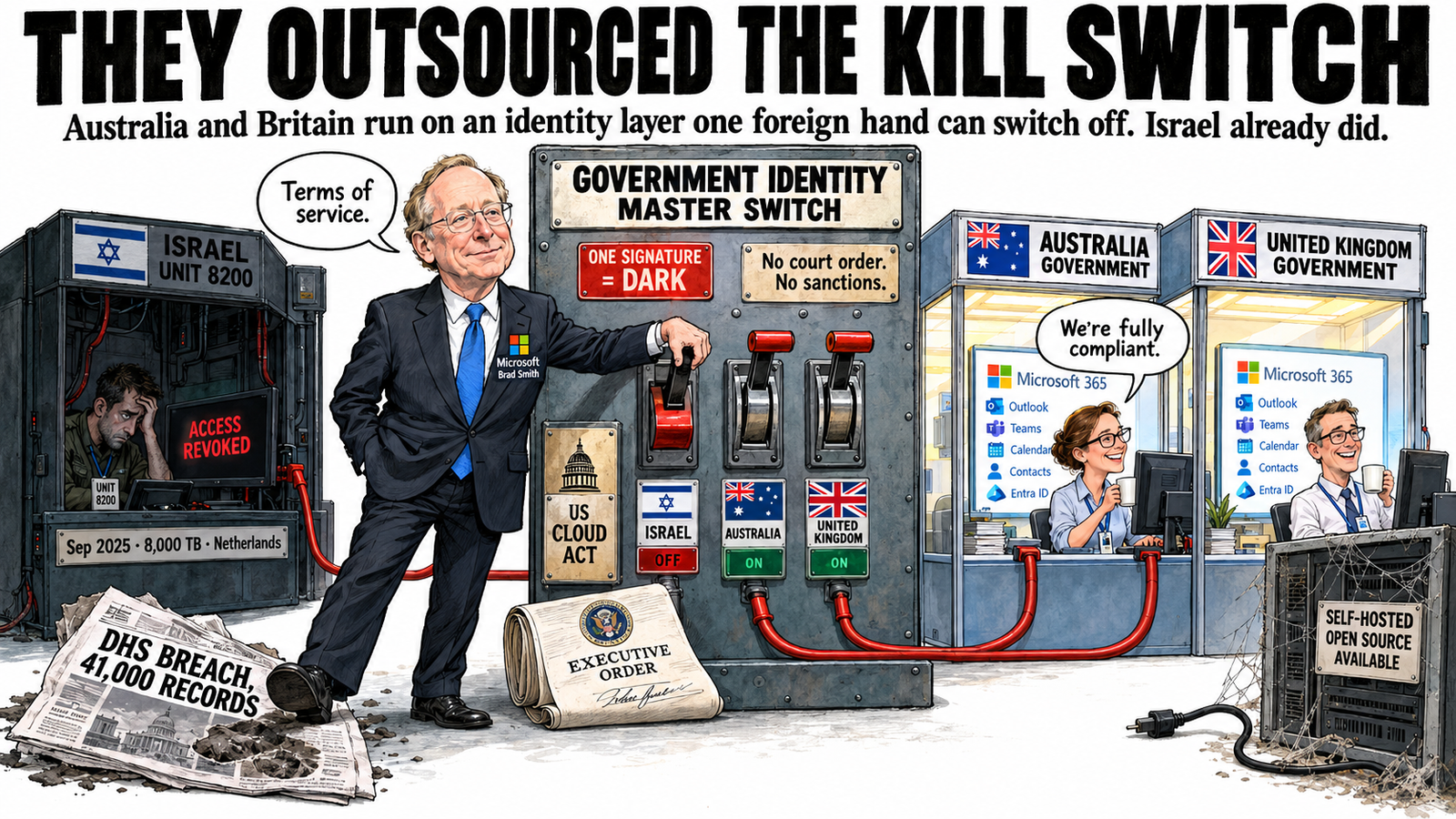
The deeper exposure is the switch, and on this axis the Western option is the more exposed, not the less. In June 2026 the United States ordered Anthropic to suspend access to its newly released Fable 5 and Mythos 5 models by unpublished letter, then lifted the controls weeks later.
The mechanism was demonstrated: access to a model that runs on American chips and compute can be cut by administrative order, reaching a deployment that is already in production. Beijing's draft export controls on model weights run the other way.
They are prospective, and they exempt anything already in the public domain, so an open model a government already holds keeps running no matter who restricts what next. A Cohere deployment does not remove the switch. It changes whose hand is on it, to the hand Carney named at Davos.
Then revenue. Cohere's CEO stated in the Globe and Mail that as of 2024, more than 90% of the company's revenue came from outside Canada. At the ALL IN conference in 2025, he put the figure at 85 to 90 percent. A company that earns 85 to 90 percent of its revenue from foreign customers is commercially aligned with foreign interests, whatever its headquarters address.
The pricing compounds the point. On published per-token rates, Cohere's flagship Command A runs about $2.50 per million input tokens and $10.00 per million output, in line with the US frontier labs and about nine times DeepSeek’s published per-token rate.
That gap is architectural, not a price Cohere could simply undercut. DeepSeek activates roughly 37 billion of its 671 billion parameters on each token, while Command A is a dense 111-billion-parameter model that runs every parameter on every one.
A sparse model carries a structurally lower cost of production, a government that self-hosts inherits that cost structure, and a dense model cannot reach the same floor whether it is built in Toronto or in San Francisco. When a government commits $1.6 billion of public money and calls the result sovereign AI, pricing the public sector can actually defend is the minimum deliverable.
Now apply the definition. Does Canada hold enforceable authority over the governance of this system? When asked directly, both parties refused to answer. Does Canada hold practical control over the operational survivability of this system? The compute runs on NVIDIA chips in an American-operated facility. The definition produces a clear answer, and the deal does not meet it.
None of this requires sovereignty to be absolute. It runs on a spectrum between dependence and control, and the charge is not that the deal is imperfect but that it sits at the dependent end while flying the flag of the other.
The performance, echoed
Carney told Davos that accommodating a hegemony is not sovereignty but the performance of sovereignty while accepting subordination. His own government's deal performs sovereignty at the investment level: a cheque written, a press conference held, a Canadian headquarters promised, no governance secured.
And then the analytical layer performs sovereignty analysis at the commentary level.
The article that prompted this analysis was not a quick social media repost. It was the full newsletter article, delivered to subscribers under the "Sovereign AI Industry Advisor" masthead. This is the product. This is what policy and decision makers receive when they subscribe.
The article restates the Prime Minister's Office press release and Cohere's own PR Newswire announcement. Its only original contributions are two sentences: one calling the deal "a bold and strategic move" and one expressing enthusiasm for working with Cohere and the Canadian government.
That does not become digital sovereignty analysis by adding two lines of enthusiasm, and it does not have to. To a reader who never compares the newsletter beside the press release, under a masthead promising sovereign AI analysis for a G7 country, it passes for the real thing. The failure is not that the scrutiny is thin, but that it is convincing enough to pass for the genuine article.
It offers no definition of sovereignty, applies no structural test, examines no infrastructure dependency, and raises no governance question. It makes no mention of CoreWeave, NVIDIA's supply chain position, Prosperity7's Saudi Aramco backing, or the 85 to 90 percent foreign revenue figure.
Measure the output against the advertised standard. The newsletter promises sovereign AI analysis for policy and decision makers. The output delivers a restated press release with commercial enthusiasm. The performance of scrutiny, while accepting the vendor narrative as given.
I am not alleging any motive or financial relationship. I am observing that if an analyst who brands himself a sovereignty advisor applies no falsifiable test to a $1.6 billion sovereignty claim, the analytical function is not being performed. The label promises scrutiny, but the output delivers amplification. The sovereignty is lost at the point of analysis, not just at the point of investment.
The mechanism
Three actors, one shared mechanism.
Cohere applies "sovereign" as a product label without meeting a structural test. The analyst applies "Advisor" as a brand label without meeting an analytical test. Canada applies "sovereign investment" as a political label without securing governance rights.
Every actor in the chain needs the word to remain undefined. None has an incentive to test it. Each performance reinforces the others, and at each stage the word loses more of its meaning.
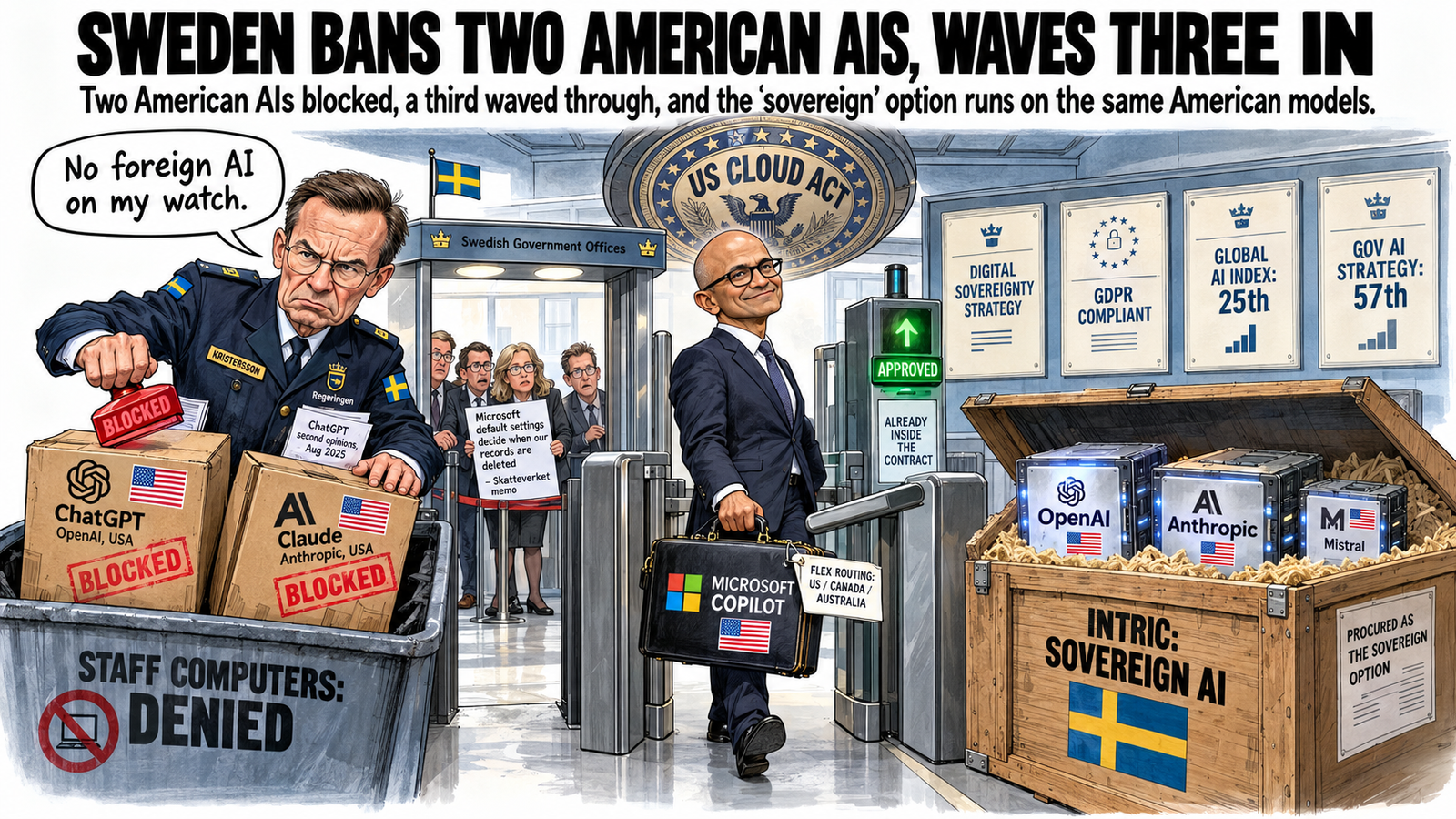
This is not unique to Canada or Cohere. The same pattern plays out with NVIDIA's sovereign AI partnerships, where a chip that NVIDIA designed but cannot fabricate, produced on a supply chain spanning Taiwan, the Netherlands, Germany, Japan, and South Korea, controlled through multiple layers of US-jurisdiction kill switches, is marketed as "sovereign" because it ships in a different coloured box.
It plays out with Saudi Arabia's Humain initiative, which distributed its compute orders across NVIDIA, AMD, Qualcomm, and Groq to reduce single-vendor concentration, only to find that every supplier in the diversified stack is American.
It plays out with European sovereign cloud announcements that run on American hyperscaler infrastructure underneath. And it plays out with India's IndiaAI Mission, which is building its national compute infrastructure on more than 38,000 GPUs that remain overwhelmingly American in origin.
Multiply this specimen by every government AI announcement on every continent and you have the mechanism by which the concept of digital sovereignty is being hollowed out globally, not by opposition but by adoption.
The cost falls on the governments least able to absorb it. A label that attaches to everything carries no information, and the buyer who most needs the signal is the one least equipped to run the structural test alone: the mid-sized state, the ministry under procurement pressure, the agency told that a cheque, a headquarters, and a press release add up to control.
These are the middle powers Carney addressed at Davos, the ones trying to hold a position between larger forces. Sovereignty washing does not disarm the strong who coined it. It disarms the ones who believed it, by selling the appearance of independence in place of the structure that would deliver it.
The standard, reclaimed
Analysts who claim sovereignty as their domain need to speak the full language of sovereignty. That means testing enforceable authority and practical control across every layer: capital structure, infrastructure stack, jurisdictional exposure, governance rights, supply chain dependencies, and operational survivability.
It means asking the questions that vendors and governments do not want asked. It means being able to produce a "no."
If all an analyst does is repeat the word "sovereign" in the same sentence as a press release, they are not analysing sovereignty. They are laundering the marketing language of the parties whose claims they are supposed to be evaluating. They are speaking the word without speaking the language.
This is the standard I hold myself to, and the same one I apply here. The people destroying the concept of digital sovereignty are not its opponents. They are its loudest advocates.
Every vendor that markets sovereignty without delivering it, every analyst who repeats the label without testing it, and every government that buys the narrative instead of building the condition is hollowing out the word from the inside.
When sovereignty becomes marketing, it loses its sovereignty and becomes performance.
The bottom line
Sovereignty is a structural condition, not a label, and it is testable. A deployment is sovereign to the degree its owner holds enforceable authority and practical control across capital, compute, model, and governance.
On that test the Cohere deal is a minority financial stake in a foreign-led company running on American infrastructure, sold under a word it has not earned. The actors hollowing out digital sovereignty are not its opponents.
They are the vendors, analysts, and governments repeating the word without building the condition, and each unexamined use makes the next one easier. Anyone who claims sovereignty as their domain owes the full test every time, including the willingness to return a no.
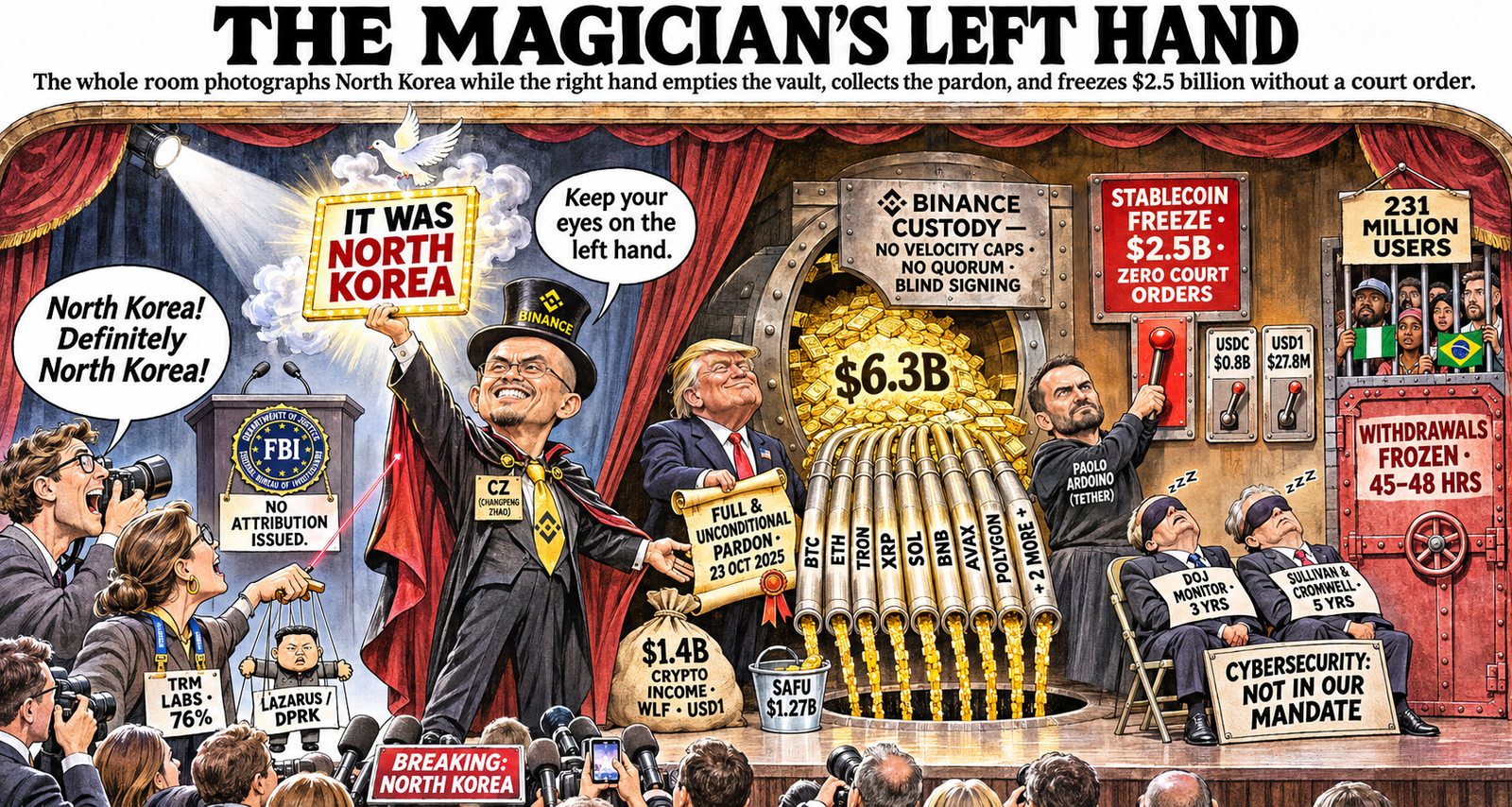
Most nations are operating on a stage that they did not build, performing a sovereignty that they do not hold, for audiences that cannot tell the difference.
Interested in digital sovereignty? Visit my book website The Digital Sovereignty Imperative: https://digitalsovereigntyimperative.com
Dion Wiggins is the CEO of SovSol, a boutique digital sovereignty research and advisory service specialising in helping governments, regulators, and enterprises understand, identify, assess, and act on structural dependency in their digital infrastructure.
#DigitalSovereignty #SovereignAI #SovereigntyWashing #AIPolicy #DigitalSovereigntyImperative